Two Years on a Four-Day Workweek
Two Years on a Four-Day Workweek
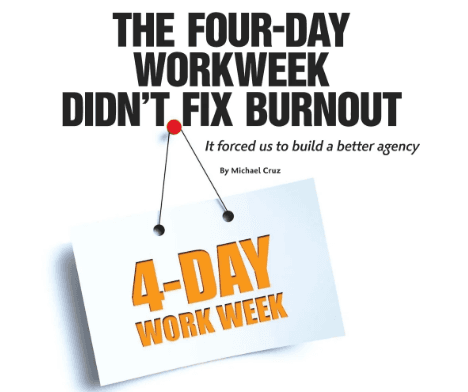
This month we're celebrating two years of a four-day workweek at Foresight Insurance. The timing worked out because my second article for Rough Notes Magazine came out this month too, and it's all about how we made it work.
I started Foresight from scratch in July 2015 and officially launched in July 2016 when we got our ERIE insurance appointment. Almost ten years in, and one of the biggest lessons is constraints force better systems. The four-day workweek is the clearest example of that I've lived through, and it's the bet that kept us standing through the hardest market in decades.
In May 2024, we moved to a 32-hour, four-day workweek. The agency still operates Monday through Friday, 9 am to 5:30 pm. Clients don't notice any difference. But most employees only work four days a week. I did it because morale was shot from the hard market and I had to think differently to keep good people. What I didn't expect was that the four-day workweek wouldn't fix our problems. It would expose them and force us to fix them.
The proof is in the numbers. We have increased our customer retention by 5% over the past two years. Customer lifetime went from 6 years to over 8 years. Tenure on my core licensed staff speaks for itself as well: one has been with my agency for nearly seven years, another two agents over five years.
The market made sure we earned every win. We parted ways with our Nationwide appointment in 2023. State Auto was bought by Liberty Mutual, and we had to try to transition that entire book to Safeco at record-breaking premium increases. Progressive non-renewed all DP3s industrywide. Another carrier ran an insurance-to-value update that raised dwelling coverage and stacked significant rate increases on top of it. All of this happened in a hard market where moving business to a new carrier was almost impossible because of strict underwriting. My team handled every bit of it while working 32 hours a week. I'm probably oversharing, but I want to be transparent about what we actually worked through.
It hasn't been all wins. We're still trying to increase our policies per customer, write more commercial and life insurance. Like most agencies, we've also lost record policies and customers, and our new business production is behind last year's pace. And with a four-day workweek, there's also constant pressure to deliver more in less time. When something goes sideways, the four-day workweek is the first thing I question and the first thing other people question too. We're winning in some areas, and we need to improve in others.
The truth is we're still in the middle of the storm. Two years of a hard market and now slowly coming into a soft market is bringing a new set of challenges. But I also need to celebrate what we've accomplished during it, because waiting until everything is perfect to acknowledge the work means never acknowledging it.
So, here's my challenge for anyone reading this: be willing to challenge the status quo of our industry. Do it for the right reasons. Your legacy, your team, your clients, your industry. Doing the bare minimum isn't enough. We need to stop accepting that working longer hours is the only way to be successful. Every one of us is facing different challenges, and there are outside forces we've all dealt with as an industry. All we can do is be the best we can be. And it starts with rethinking everything and being willing to take the risk of doing things differently.
I'm not saying our way is the only way. It's my way. My crazy idea to cut my team’s work hours is probably a few years ahead of schedule, but I'm bullish that a 32-hour workweek will be the norm soon enough. We all need to work less and live more.